History and highlights
Dolmabahçe Palace history
The history of Dolmabahçe Palace, from a filled-in bay to the Republic: the sultan who built it, the Balyan architects, its cost and its best-known rooms.
Book your palace visit ↗Quick answer
Sultan Abdülmecid I ordered Dolmabahçe Palace, and it went up between 1843 and 1853 on a bay of the Bosphorus that had been filled in to make a garden. The Balyan family of architects designed it, blending Baroque, Rococo and Neoclassical styles with Ottoman planning. Six sultans lived there, and in 1924 it passed to the Republic. Mustafa Kemal Atatürk died in the palace on 10 November 1938.
A bay the sultans filled in
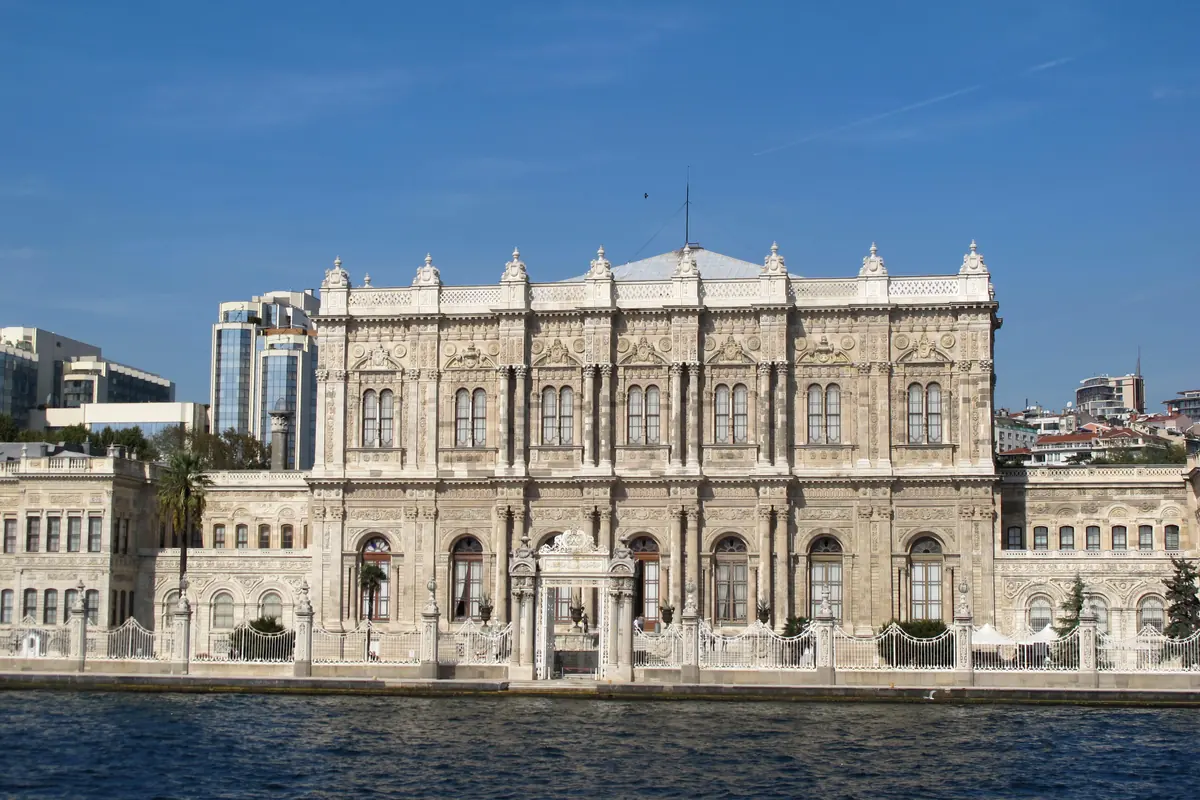
The site of Dolmabahçe was originally a bay on the Bosphorus where the Ottoman fleet anchored. It was filled in from the 17th century onwards and became an imperial garden, and the name keeps that history: dolma means filled and bahçe means garden. Wooden pavilions and small summer palaces rose there and formed the Beşiktaş Waterfront Palace, which Sultan Abdülmecid I had demolished to make room for a new stone palace. The plot covers about 110,000 square metres, bounded by the Bosphorus on one side and a steep slope on the other. The National Palaces' history adds that Mehmed the Conqueror is thought to have had his ships hauled from this bay, a belief and not a documented fact.
Why the sultan left Topkapı
Abdülmecid I, who reigned from 1839 to 1861, was the empire's 31st sultan, and he and his family had lived at the Topkapı Palace, which had served the dynasty for about four centuries. By the 1840s medieval Topkapı looked dated beside the palaces of European monarchs, lacking their contemporary style, luxury and comfort, and the sultan decided to build a modern residence. The palace's layout and décor reflect the growing influence of European styles and standards on Ottoman culture and art during the Tanzimat, the period of reform in the 19th-century empire. The building was begun in 1843 and finished in 1853, and it is a statement of that outlook in marble.
The Balyan family
The architects were members of the Balyan family, Armenian court architects who served the Ottoman sultans for five generations and designed palaces, mosques, churches and mansions across Istanbul. For Dolmabahçe the project was realised by Garabet Balyan, who lived from 1800 to 1866, his son Nigoğayos Balyan and Evanis Kalfa. The Directorate of National Palaces, which looks after the building today, also names Ohannes Serveryan and James William Smith among its builders, and it records that Hacı Said Ağa oversaw the works from 1843 to 1850, followed by Esseyyid Ali Şahin Bey until 1856. The palace was a team's work, with the Balyans at its head.
What it cost
The construction cost has been put at five million Ottoman lira, equivalent to 35 tonnes of gold, which was approximately a quarter of the empire's yearly tax revenue. It was financed through debasement, a large issue of paper money and foreign loans. The expense placed a heavy burden on the state purse and contributed to the worsening finances that ended in the Ottoman Empire's default on its public debt in October 1875. That default led in 1881 to the Ottoman Public Debt Administration, through which European powers exercised financial control. The palace therefore stands in two stories: a showpiece of reform, and a bill that the state struggled to pay.
- Cost: five million Ottoman lira
- Equivalent: 35 tonnes of gold
- Share of the empire's yearly tax revenue: approximately a quarter
- Financed by: debasement, paper money and foreign loans
One building, three parts
The palace is one long block with a strict internal division, and the Directorate of National Palaces describes a main structure of two regular floors, an attic and a basement. The southern wing, the Selamlık, held the public and representation rooms, where the state's business was done and diplomats were received. The northern wing, the Harem, was the private residential area for the sultan and his family and was kept apart from the outside world. Between them stands the Ceremonial Hall, whose floor covers 2,000 square metres under a dome 36 metres high. The directorate counts 285 rooms and calls it the largest palace in Türkiye. From the Bosphorus the exterior reads as a classical European arrangement of two wings divided by a large central projecting block.
- Selamlık: the southern wing for state business and diplomats
- Ceremonial Hall: the 2,000 square metres between the wings
- Harem: the northern wing for the sultan and his family
Gold, crystal and carpets
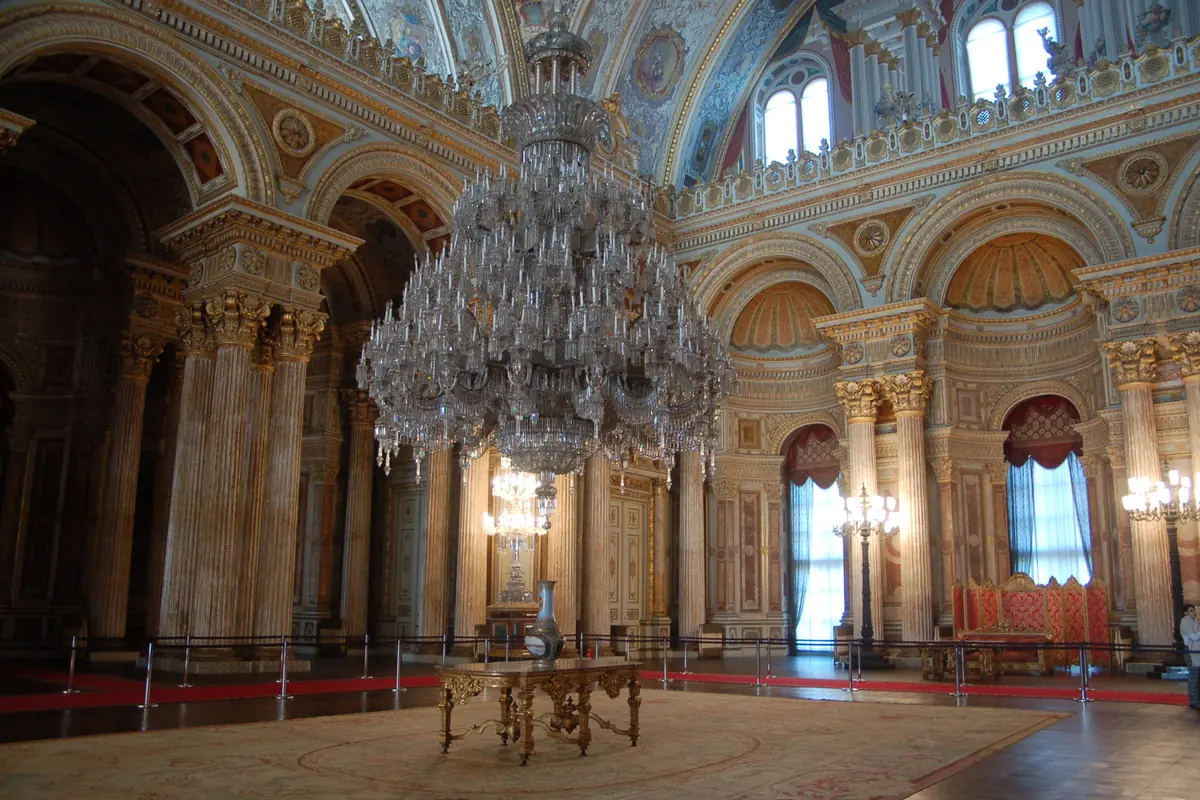
Where Topkapı is known for its Iznik tiles and carved ornament, Dolmabahçe is lavish with gold and crystal. Fourteen tonnes of gold were used to gild the ceilings, and the palace holds what is described as the most extensive collection of Bohemian and Baccarat crystal chandeliers in the world. The Crystal Staircase has the shape of a double horseshoe and is built of Baccarat crystal, brass and mahogany. Marble from Marmara Island, Egyptian alabaster and porphyry from Pergamon were used in the decoration, alongside Sèvres and Yıldız porcelain and gifts from state leaders. The Hereke carpet in the main hall is said to be the largest Hereke rug in the world.
- Ceilings: fourteen tonnes of gold gilding
- Staircase: Baccarat crystal, brass and mahogany
- Stone: Marmara Island marble, Egyptian alabaster and porphyry from Pergamon
- Textiles: carpets from the Hereke Imperial Factory
Read next: What to see in Dolmabahçe Palace
The chandelier and the receipt
The Ceremonial Hall, where the sultan received the notables of the state on religious days and where state ceremonies were held, holds a crystal chandelier of 750 lamps that weighs 4.5 tonnes and is described as the world's largest. For a long time it was assumed to have been a gift from Queen Victoria. In 2006 a receipt was found that showed the sultan had paid for it in full himself. The hall's floor covers 2,000 square metres and its dome rises 36 metres, so the chandelier hangs in a room built for large occasions.
Modern for its day
From the beginning the palace was equipped to the highest technical standards of its time. Gas lighting and water-closets were imported from Great Britain at a time when other palaces in continental Europe still lacked them, and electricity, central heating and a lift were installed later. A collection of 202 oil paintings is on display, including 23 by Ivan Aivazovsky, who painted them as a court painter during his stays in Istanbul, and works by Gustave Boulanger, Jean-Léon Gérôme, Eugène Fromentin and the Turkish painter Osman Hamdi Bey. The wider complex also includes a glass factory, a foundry, an aviary, stables and the Crown Prince's apartment, and the clock tower was added under Abdülhamid II.
From sultans to the Republic
Six sultans lived at Dolmabahçe, and the last caliph, Abdülmecid II, lived there from 1922 until the caliphate was abolished in 1924. From 1853 to 1887 and again from 1909 to 1922 the palace served as the main administrative centre of the Ottoman state. A law that took effect on 3 March 1924 transferred its ownership to the national heritage of the new Turkish Republic. Atatürk used it as a presidential residence, mostly in the summers, and the Directorate of National Palaces says he stayed there intermittently between 1927 and 1938. It continued as a presidential residence under İsmet İnönü until 1949 and opened to visitors as a palace-museum in 1984.
Dates at a glance
| Year | What happened |
|---|---|
| 1843 | Building begins |
| 1853 | Construction ends |
| 1924 | The Republic takes ownership |
| 1938 | Atatürk dies in the palace |
| 1949 | Last use as a presidential residence |
| 1984 | Opens as a palace-museum |
The room where the clocks stopped
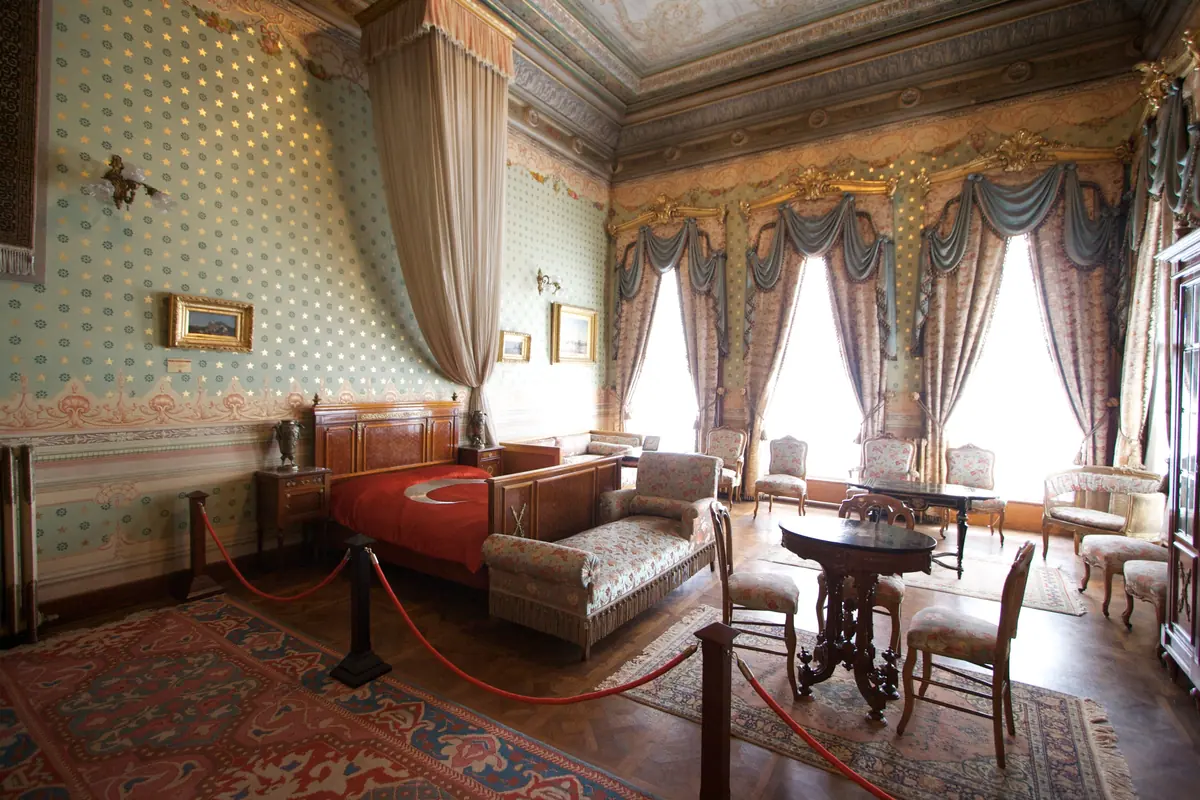
Mustafa Kemal Atatürk, the founder and first President of the Republic, spent the last days of his illness at the palace. He died at 9:05 on the morning of 10 November 1938, in a bedroom in the former harem area. All the clocks in the palace were stopped and set to 9:05 after his death. The clocks outside his room now show the actual time, but the clock in the room where he died still points to 9:05. His casket lay in the palace's reception hall in the days that followed, and for three days thousands of mourners passed it. The room is reached within the Harem section, which the GetYourGuide tickets in this guide cover.
Who this history isn't for
Readers after the practical side should skip to the guides on getting there and on when to go. This page covers the history of the building, not the history of the empire: the Tanzimat reforms, the 1875 default and the end of the sultanate each have long accounts of their own, and this guide touches them only where they explain the palace. For a room-by-room walk, the guide to what to see inside follows the plan of the building in order, and the guide to the Bosphorus explains why the palace stands where it does.
Read next: What to see in Dolmabahçe Palace
Frequently asked questions
When was Dolmabahçe Palace built?
Between 1843 and 1853, for Sultan Abdülmecid I, on a filled-in bay of the Bosphorus. It took over from the Topkapı Palace as the sultans' home and as the empire's seat of administration.
Who designed Dolmabahçe Palace?
Members of the Armenian Balyan family of court architects: Garabet Balyan, his son Nigoğayos Balyan and Evanis Kalfa. They blended Baroque, Rococo and Neoclassical styles with Ottoman planning.
Was the chandelier a gift from Queen Victoria?
It was long assumed to be, but a receipt found in 2006 showed that the sultan paid for it in full himself. It hangs in the Ceremonial Hall and has 750 lamps.
When did Atatürk die at the palace?
On 10 November 1938 at 9:05 in the morning, in a bedroom in the former harem area. The clock in that room still points to 9:05.
Who lived at Dolmabahçe Palace?
Six sultans lived there, followed by the last caliph, Abdülmecid II, until the caliphate was abolished in 1924. Atatürk later used the palace as a presidential residence, mostly in the summers.
Is Dolmabahçe the largest palace in Türkiye?
Yes. The Directorate of National Palaces describes it as the largest palace in Türkiye, a single block with 285 rooms on the shore of the Bosphorus.
Sources